
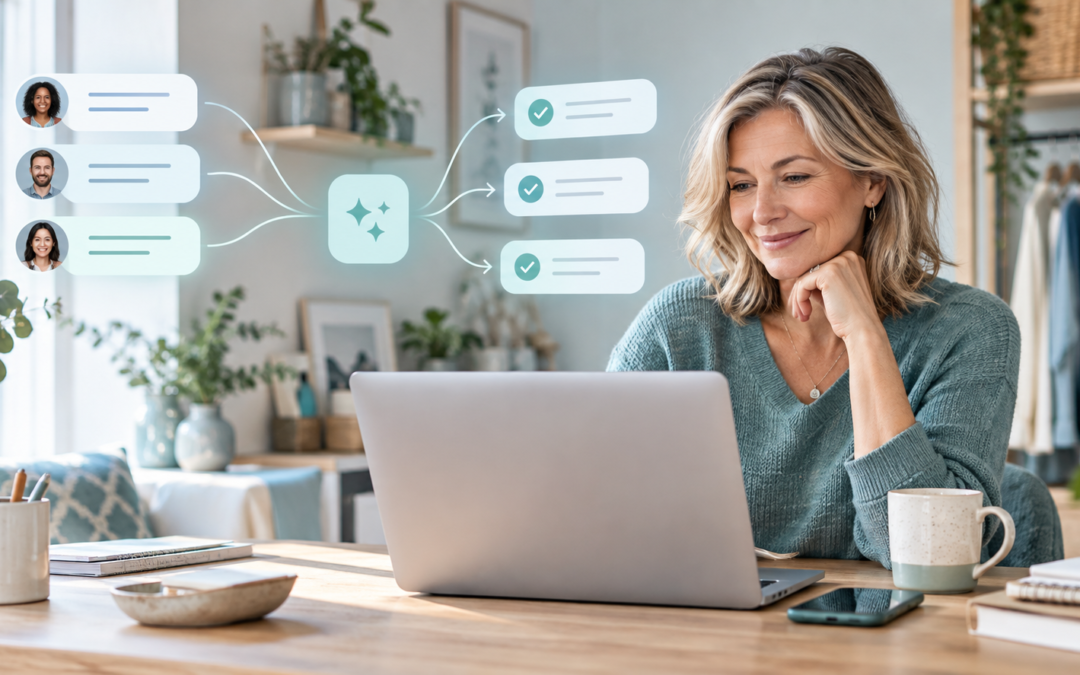
Would you like to automate customer enquiries but worry that your business may lose its personal touch?
Small business owners often answer the same questions every day. Customers want to know your prices, opening hours, availability or how to book. Each question may only take a few minutes to answer. However, those minutes soon add up.
Customers also expect quick responses. If they cannot find an answer, they may move on to another business.
Fortunately, automation can help. It can answer simple questions, capture useful information and guide customers towards their next step. Meanwhile, you remain available for the conversations that need a human response.
What does it mean to automate customer enquiries?
Customer enquiry automation uses technology to answer questions or manage the first stage of an enquiry.
For example, your business could use:
- Automatic email responses
- Frequently asked questions on your website
- AI-powered messaging
- Website chatbots
- Automated Facebook or Instagram replies
- Online booking systems
- Follow-up emails
- Enquiry forms that collect essential information
Automation does not have to be complicated. In fact, a clear FAQ page or a well-written automatic reply may be all you need.
The goal is simple. Customers should receive useful information quickly, while you spend less time answering repetitive questions.
Why should small businesses automate customer enquiries?
There are several reasons to introduce automation into your customer journey.
Customers receive faster answers
Potential customers may contact several businesses at the same time. Therefore, a quick and helpful response can make a real difference.
Automation can provide information while you are busy or outside your normal working hours. As a result, customers do not have to wait until you are available.
You reduce repetitive administration
Do you answer the same questions every week? If so, these questions may be suitable for automation.
For example, you could automate answers about:
- Opening hours
- Prices
- Appointment availability
- Delivery areas
- Booking instructions
- Parking
- Check-in times
- Services offered
This gives you more time to serve customers and run your business.
Your information becomes more consistent
Automated messages help customers receive the same accurate information each time.
However, you must review that information regularly. Prices, opening hours and policies can change. An outdated automated answer can quickly create confusion.
You receive better-quality enquiries
Automation can collect important details before you contact a potential customer.
For instance, an enquiry form could ask about the service required, the customer’s location and their preferred date. Consequently, you will already understand their needs when you respond.
How can AI-powered messaging help small businesses?
AI-powered messaging for small businesses can provide more flexible responses than a standard automatic reply.
A basic automated message sends the same answer to everyone. In contrast, an AI chatbot can interpret a question and select relevant information.
For example, a hotel chatbot could answer questions about breakfast, parking and check-in. A dental practice could explain how to register or request an appointment. Similarly, a tradesperson could collect details about a job before arranging a call.
These are practical AI tasks for small businesses in 2026. They are no longer limited to large companies with large technology budgets.
Nevertheless, the chatbot must use accurate information. It should also make it easy for customers to speak to a person.
Will an AI chatbot make my business feel impersonal?
A badly designed chatbot can feel impersonal. A helpful one should not.
Firstly, the chatbot should clearly identify itself as an automated assistant. It should never pretend to be a member of your team.
Secondly, its language should sound like your business. A family-run hotel will use a different tone from a law firm or engineering company.
Finally, customers must have a clear way to reach a person. Nobody wants to become trapped in a loop of unsuitable automated answers.
Good automation supports personal service. It should never become a barrier between you and your customers.
What should your business automate first?
Before investing in new software, look at the enquiries you already receive.
Start with questions that are:
- Frequently asked
- Simple to answer
- Unlikely to require personal judgement
- Taking up a large amount of your time
- Preventing customers from taking their next step
Next, examine what happens after someone contacts you.
Do they receive confirmation? Do they know when you will respond? Can they find your prices or booking information? Is the next step clear?
Sometimes a better website page will solve the problem. Alternatively, you may need an automatic email, an improved enquiry form or an AI chatbot.
The right choice depends on your customers and how your business operates.
What should not be fully automated?
Automation works best for predictable questions. However, some conversations still need a person.
These may include:
- Complaints
- Sensitive information
- Unusual requests
- Complex purchasing decisions
- Situations that require professional judgement
- Customers who need additional support
You should also check any AI-generated response before relying on it. AI can provide incorrect or incomplete information with surprising confidence.
Ultimately, your business remains responsible for the information given to customers.
Does every small business need an AI chatbot?
No. An AI chatbot can be useful, but it is not automatically the right solution.
Before adding one, ask:
- Which questions do customers ask repeatedly?
- Where are enquiries currently being missed?
- What causes confusion during the customer journey?
- Could clearer website content solve the problem?
- Who will review and update the answers?
- Can customers easily contact a person?
Technology should solve a genuine business problem. Otherwise, it may become another monthly cost that delivers little value.
How to automate customer enquiries successfully
If you want to automate customer enquiries, start small.
Choose one repeated task and improve it. Then, monitor whether the change saves time or helps customers take action.
You can gradually introduce more automation once you understand what works. This approach reduces risk and prevents you from investing in unnecessary systems.
Most importantly, keep the human element. Let automation handle predictable questions while you focus on building relationships and solving more complex problems.
Not sure what your business should automate?
Sea Glass Marketing helps small businesses identify gaps in their marketing and customer journey before they invest in more technology.
We look at how customers discover your business, what happens when they make an enquiry and where valuable opportunities may be getting lost.
Book your Mini Gap Analysis to discover how smarter marketing and carefully chosen automation could save you time, improve your customer experience and generate more valuable enquiries.